The best kitchen scales for baking help you measure flour, sugar, butter, and other ingredients with greater accuracy. Whether you enjoy making cookies at home or regularly bake bread, a reliable digital kitchen scale can improve your results. Unlike measuring cups, kitchen scales measure ingredients by weight, which helps reduce measurement errors. As a result, choosing the right model can make everyday baking easier and more consistent.
Why Do You Need a Kitchen Scale for Baking?
Baking requires accurate ingredient measurements. Even a small difference in flour or sugar can change the texture of cakes, cookies, and bread.
However, measuring cups may produce different results because ingredients settle differently. For example, one cup of flour can weigh more when someone packs it tightly into a measuring cup.
A digital kitchen scale solves this problem by displaying the exact weight. Additionally, most models allow you to switch between grams, ounces, and pounds.
Choosing the right tools is also important for an efficient kitchen. Therefore, read our complete commercial kitchen equipment buying guide to learn more about selecting essential kitchen equipment.
Furthermore, a digital kitchen scale helps bakers measure ingredients accurately. Consequently, they can achieve more consistent baking results while reducing the need for multiple measuring cups.
Here are some important benefits:
Better accuracy: Measure ingredients according to the recipe.
Consistent results: Repeat measurements for future batches.
Less cleanup: Weigh several ingredients in the same mixing bowl using the tare function.
Easy portion control: Divide cookie dough, cake batter, and bread dough evenly.
Faster preparation: Spend less time washing measuring cups and spoons.
5 Best Kitchen Scales for Baking
Different bakers need different features. For instance, some prefer an affordable digital scale, while others need a larger model for bread dough and frequent baking.
The following options offer different combinations of accuracy, capacity, convenience, and functionality. However, product availability and specifications may vary by retailer and model version.
1. Escali Primo Digital Kitchen Scale – Best Overall
The Escali Primo Digital Kitchen Scale is a practical choice for everyday baking. Its simple controls make it suitable for beginners as well as experienced home bakers.
This model offers an 11-pound capacity and measures in 1-gram increments. Additionally, its compact design makes storage easy after you finish baking.
Key features:
Maximum capacity of 11 pounds.
Measurements in grams, ounces, and pounds.
Simple two-button operation.
Compact and lightweight design.
Easy-to-clean weighing platform.
Pros:
Simple to operate.
Reliable measurements in independent testing.
Suitable for everyday baking tasks.
Cons:
No backlit display.
Does not measure below 1-gram increments.
Best for: Home bakers who want a dependable and straightforward digital scale.
2. My Weigh KD-8000 – Best for Serious Bakers
The My Weigh KD-8000 Digital Food Scale offers additional features for people who bake frequently. In particular, its larger weighing capacity makes it useful for preparing bread dough and measuring larger ingredient batches.
One standout feature is baker’s percentage mode. This function helps bakers calculate ingredient quantities based on the weight of flour.
Moreover, the model supports several measurement units and offers an adjustable automatic shut-off function.
Key features:
Maximum capacity of 8,000 grams.
1-gram measurement increments.
Baker’s percentage function.
Large weighing platform.
Battery and AC adapter power options.
Pros:
Useful for bread-making.
Supports larger ingredient batches.
Offers specialized baking functions.
Cons:
Larger than many standard kitchen scales.
May offer more features than occasional bakers need.
Best for: Serious home bakers, bread makers, and people who regularly prepare large batches.
3. Amazon Basics Digital Kitchen Scale – Best Budget Option
The Amazon Basics Digital Kitchen Scale provides essential weighing functions at an affordable price. Therefore, it is a reasonable starting point for beginners who want to try baking with accurate measurements.
Its stainless-steel weighing surface makes everyday cleanup simple. Furthermore, the digital display allows users to check ingredient weights quickly.
Key features:
Maximum capacity of approximately 11 pounds.
Measurements in grams and other common units.
Digital LCD display.
Stainless-steel weighing platform.
Compact design.
Pros:
Budget-friendly option.
Simple controls.
Suitable for common kitchen tasks.
Cons:
Basic design.
Button areas may collect crumbs.
Does not offer advanced baking functions.
Best for: Beginners and occasional bakers who want an affordable digital scale.
4. OXO Good Grips Stainless Steel Food Scale – Best for Easy Reading
The OXO Good Grips Stainless Steel Food Scale focuses on convenience and practical design. For example, its pull-out display helps users read measurements when a large mixing bowl covers part of the scale.
This feature can make a noticeable difference when preparing cake batter or bread dough. Additionally, the removable weighing platform makes cleaning easier.
Key features:
Stainless-steel weighing platform.
Pull-out display.
Easy-to-read measurements.
Removable platform for cleaning.
Practical design for larger containers.
Pros:
Convenient display placement.
Easy-to-clean platform.
Useful for larger mixing bowls.
Cons:
Costs more than basic digital models.
May not offer the best value for occasional bakers.
Best for: Regular bakers who prioritize convenience and easy-to-read measurements.
5. Escali Arti Glass Kitchen Scale – Best Stylish Option
The Escali Arti Glass Kitchen Scale combines a modern appearance with useful weighing functions. Its glass surface gives it a clean look that fits many contemporary kitchens.
Additionally, the model includes common weighing functions and a hold feature. Consequently, it can be convenient when you need to keep a measurement visible while working with ingredients.
Key features:
Glass weighing surface.
Digital measurement display.
Multiple measurement units.
Hold function.
Modern countertop design.
Pros:
Attractive appearance.
Convenient weighing functions.
Smooth surface for everyday cleaning.
Cons:
Glass requires careful handling.
Costs more than some basic alternatives.
Best for: Home bakers who prefer a stylish kitchen scale with practical features.
Important Features to Consider When Buying a Baking Scale
Not every baker needs the same features. For example, beginners may prefer a simple and affordable model. In contrast, experienced bakers may need additional measurement functions.
Before purchasing a digital kitchen scale, compare its specifications and everyday functions. Ultimately, the right combination of features will depend on the recipes you prepare most often.
Furthermore, measurement accuracy should match your baking needs. Regular home baking usually requires 1-gram increments. However, recipes involving very small quantities may need a more precise scale.
1. Measurement Accuracy
Accuracy should be your first consideration. Generally, most home bakers can work comfortably with a scale that measures in 1-gram increments.
However, recipes involving small amounts of yeast, salt, or other ingredients may require greater precision. In such cases, consider a separate precision scale.
2. Weight Capacity
A scale’s maximum capacity determines how much weight it can handle.
For regular home baking, an 11-pound capacity usually provides enough room for mixing bowls and ingredients. On the other hand, serious bakers may prefer a higher-capacity model for large bread batches.
3. Tare Function
The tare function resets the displayed weight to zero while a bowl or ingredient remains on the platform.
For example, place an empty bowl on the scale and press the tare button. Next, add flour until the display shows the required amount. Afterward, press tare again before adding sugar or butter.
As a result, this feature makes measuring multiple ingredients much easier.
4. Measurement Units
Choose a model that supports grams and ounces. These units are particularly useful when following recipes from different countries.
Additionally, some scales include pounds, milliliters, and fluid ounces. Nevertheless, remember that milliliter measurements depend on the ingredient and its density.
5. Display and Button Design
A clear display helps you check measurements without moving the mixing bowl. Moreover, backlit screens can improve visibility in kitchens with limited lighting.
Meanwhile, large buttons make it easier to operate the scale during busy baking sessions.
6. Cleaning and Storage
Flour, sugar, and sticky ingredients can collect around the weighing platform and buttons.
Therefore, look for a smooth surface that you can wipe clean easily. Similarly, a compact design helps when you have limited countertop or cabinet space.
How to Use a Digital Kitchen Scale for Baking

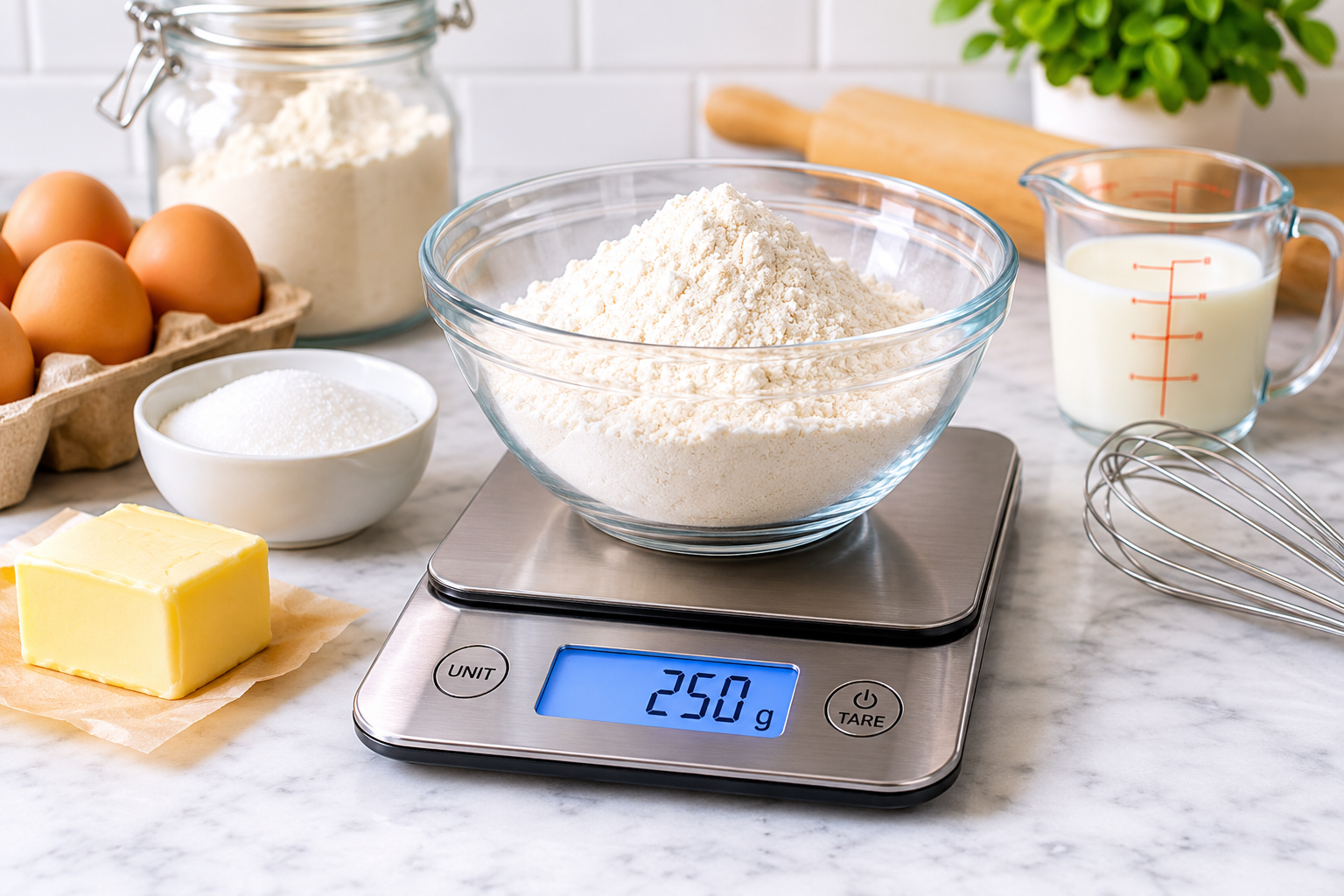
Measuring flour accurately with a digital kitchen scale.
First, place the scale on a flat surface. Next, select your preferred measurement unit. Then, place an empty bowl on the platform and press the tare button. Finally, add the ingredients according to your recipe.
A digital kitchen scale is easy to operate once you understand its basic functions.
Additionally, you can explore our guide on how to use a food processor to learn more about preparing ingredients efficiently.
Follow these steps for accurate measurements:
Place the scale on a flat, stable countertop.
Turn on the digital display.
Select grams or your preferred measurement unit.
Place an empty mixing bowl on the weighing platform.
Press the tare button to reset the reading to zero.
Add the first ingredient until you reach the required weight.
Press tare again before measuring another ingredient.
For example, if a recipe requires 250 grams of flour and 150 grams of sugar, measure the flour first. Afterward, reset the scale and add the sugar to the same bowl.
Consequently, you can measure multiple ingredients without using separate measuring cups.
Kitchen Scale vs. Measuring Cups: Which Is Better for Baking?
Both tools have a place in the kitchen. However, they measure ingredients differently.
Feature | Kitchen Scale | Measuring Cups
Measurement method | Weight | Volume
Accuracy | More consistent | Depends on filling technique
Unit options | Grams and ounces | Cups and fractions
Cleanup | Usually easier | May require several cups
Best use | Precise baking | Quick everyday measurements
For most baking recipes, a kitchen scale offers more consistent measurements. For instance, King Arthur Baking recommends digital weighing and lists ingredient weights to help bakers follow recipes accurately.
Additionally, you can use the ingredient weight chart from King Arthur Baking to compare the weight of common ingredients in grams and ounces.
Nevertheless, measuring cups remain useful when a recipe provides volume measurements.
Common Mistakes to Avoid When Using a Baking Scale
Even a good kitchen scale cannot guarantee accurate results if you use it incorrectly. Fortunately, a few simple habits can prevent common measurement problems.
Using an uneven surface: Always place the scale on a stable countertop.
Skipping the tare function: Reset the reading before adding another ingredient.
Exceeding the weight limit: Check the maximum capacity before weighing heavy bowls.
Ignoring measurement units: Confirm grams or ounces before following a recipe.
Adding ingredients too quickly: Pour slowly to avoid exceeding the required amount.
Ignoring cleaning: Remove flour and food residue after each baking session.
In addition, check the batteries regularly. Otherwise, low battery power can interrupt your baking preparation and may affect the display.
Which Kitchen Scale Is Best for Your Baking Needs?
The right choice depends on your budget, baking frequency, and preferred features.
For most home bakers, the Escali Primo offers a useful balance of simplicity, capacity, and accuracy. Meanwhile, the My Weigh KD-8000 suits people who make bread regularly and want baker’s percentage functionality.
If you are shopping on a tight budget, the Amazon Basics Digital Kitchen Scale covers basic weighing needs. Alternatively, OXO offers a convenient design for users who frequently work with large mixing bowls.
Ultimately, your choice depends on your budget and baking habits. Therefore, compare the available features before purchasing. Additionally, consider the scale’s capacity, accuracy, and cleaning convenience. The best kitchen scales for baking should make ingredient measurements simple, reliable, and consistent.
- All Posts
- Buying Guides
- Commercial Kitchen
- Kitchen Equipment
- Product Reviews
- Tips & Maintenance